Friday, 23 December 2016

Saving Mr. Banks

P.L Travers is broke. Her royalties have dried up. There has been a film rights offer on the table for 20 years, but Travers is highly protective of her work. The first 4 minutes of Saving Mr. Banks sets up the story with the subtlety of a sledgehammer. Let me explain though how I came to love this film.


Emma Thompson is forceful, aggressive, yet very entertaining as P.L Travers. Throughout most of the film every line of dialogue she has is overly cynical and is delivered with a 'very English' demeanor, which is to say overt contempt. Even when others are being nice to her or trying to raise her spirits, such as her cheery and well meaning driver played excellently by Paul Giamatti. Mrs. Travers' stubbornness is never more evident than when Thompson reacts with disgust to finding her hotel room has been decorated with Disney toys and Mickey Mouse merchandise. Not even the magic of Disney can phase P.L Travers' bitterness. Many of my thoughts on the film to this point can be summed up by the moment Mrs. Travers removes the giant Mickey Mouse toy from her bed and sits it facing the wall, murmuring "you can stay there until you learn the art of subtlety". This line had me howling with laughter for the wrong reasons, because at this point I almost did the same to my TV. Attempts to put her character over the top could easily have felt overbearing in the hands of the wrong actress, but they are entertaining thanks to Emma Thompson. I'd expect no less from a footlights graduate in the same class as Stephen Fry and Hugh Laurie. Thompson's P.L Travers appears completely unflappable even after she finally meets with Walt Disney face to face. Mrs. Travers might not have been enamoured, but I was.

Walt Disney is played in this film by Tom Hanks, who brightens up the screen from the moment he walks onto it surrounded by trophies and memories. Hanks' performance made me smile every time he was on screen, and thats high praise for a character whose sole motivation is to acquire the rights to Mary Poppins. Once again motivations are made very clear very fast, as Disney wastes no time in stressing how long he had been wanting to purchase the rights, 20 years in fact. Tom Hanks made me smile every moment he was on the screen, and that, at least to someone of my generation, is what you would expect the mythical Walt Disney to do. The film does attempt in small ways to dethrone the cinema legend. One of the more notable instances of this is where he is caught smoking in his office, a habit he didn't want revealed publicly in fear that it would taint his wholesome image. Given that this is a Walt Disney Pictures film co-starring Walt Disney, this is as much dirt on the Hollywood icon we're going to get. I don't know much about the man himself beyond Disney's own media, but Hanks' Disney seems to care a great deal about his self image, and the impression he leaves on the world, and that is what makes him fascinating. The only other real slight on him is the lack of effect his charm has on Mrs. Travers, and this creates great chemistry between the two sides of the same coin.


Saving Mr. Banks does a great job at building P.L Travers as a magnificently stubborn character but then explaining deeply what made her that way. In sections throughout the film we are shown small segments of her early life. These are helpful in providing some interesting background, as well as giving us an entertaining Colin Farrell performance as Mrs. Travers' father, an increasingly complex character who wants to please his children to a fault. These flashbacks are cut into the story very well and they never feel intrusive or forceful. Given that the writers of this film seem to have no trust in the audience to work the plot out for themselves, the line "we have to teach the witch to be happy again" feels like another blow from that aforementioned subtlety sledgehammer. These scenes come to signify the struggle between Travers' headstrong defiance and her childhood memories of imagination and creativity powered by her father, especially when they are placed alongside his inevitable implosion. A line in the trailer tells you all you need to know, as does the films title itself. These asides begin to make you realise how important Mrs. Travers' creation is to her and why. We see why she aggressively protects her beloved Mary and the Banks'. It is here where we discover the core of her character, and I like how this builds throughout the film.

One the greatest things for me about Saving Mr. Banks is the musical score by Thomas Newman. At one point Newman invokes 'Hi Ho' from Snow White when introducing the Disney studios, a film that would have enraged Travers given her hatred for Disney's 'Silly Cartoons'. At this point I was struck by the irony that I was watching a film depicting a person who heavily resisted her own work being brought to the silver screen, yet is now on it herself. Newmans score conveys despair when you are looking at it, and joy when you are looking at that too. Ever since I saw American Beauty I have been able to spot a Thomas Newman score, and this made me enjoy the film even more.

If I were to describe the tone of this film in one word, it would be 'sunny', and this is evident even
from the photography. There are plenty of bright colours and vivid landscapes that make the film easy on the eyes. California is of course portrayed with nothing but sunshine, and the flashbacks are almost glowing with vibrance. The plot is filled with conflict and angst, so you really needed that bright tone to remind you that this is a Disney film.There was also a fair amount of humour drawn from Travers' conflict with Disney's writers and musical staff who each have their moment of levity. My favourite being a debate over the word "responstible" not being a word.

When we screened Saving Mr. Banks as part of our Film Club season some left the film on the edge of tears. This was soon alleviated by an extra I hadn't known existed in the credits of the real P.L Travers in the tape recorded writing sessions that are recreated in the film. Without saying too much these extras definitely serve the authenticity of the film, and I would hope that more of these tapes were made available someday, so that we might understand the creative process a bit more. This film succeeded in that is took a potentially combative and unfilmable thing, a business deal, and sprinkled some of that Disney magic on to make it both engaging and entertaining throughout.

***1/2

Thursday, 1 December 2016

Absolutely Fabulous (2016)

Reels on fire...

Absolutely Fabulous (1990-2004) hit TV screens in an era where neanderthals were still arguing that
women can't be funny, and it therefore had a lot to prove. The film arrived in an era where that stereotype on both big and small screen has beeb obliterated. Jennifer Saunders and Joanna Lumley make it clear early on that they are out to make fun of themselves, and not just others as the style of modern comedy has become. nothing is off limits, how they have aged, how the world has changed, and this is where some of the best comedy comes. Their lack of understanding of the world is at times amazing, with Patsy referring to cash as 'hand money' being my favourite gag. I got the feeling early on that Ab Fab was two decades before its time, and the film is right where it needed to be given that we now live in the media obsessed celebrity culture. However the more I watched, I realised that the comedy doesn't work anymore given that we are too close to the world the series was parodying in the 1990's. Sadly, we have become the joke.

Being a film set in the world of PR and celebrity there are cameos aplenty which range from fantastic to dire. Gwendoline Christie (Brienne of Tarth from Game of Thrones) looking glamorous for a change was brilliant, while I could have done without Richard Arnold and Christine Bleakley (who is bizarrely only shot from the side for some reason). That guy from the X Factor who plays an air steward (appropriately) can fuck off too. There is no doubt however that they deserve a place in this film given that it takes a sledgehammer to gaudy celebrity culture at some points and lusts for it at others. Jon Hamm also puts in a great but too brief comic performance, and this all serves to make series mainstays Lulu and Emma Bunton come across as jarring anachronisms. While their inclusion is faithful to the original I found it hard to believe that they exist in this world anymore. So many cameos are included that by the end of the film they become numbing. From genuinely funny moments to "oh yeah its him/her". Crucially the biggest anachronism is Kate Moss, who is an important part of the plot.

Much like Brienne's appearance I greatly appreciated the cameo by Rebel Wilson, who begged for a role in the film and ad-libbed her greatest line. As a air hostess she refers to herself as the 'designated do noting bitch', which is a glorious reference to MMA great Ronda Rousey's coined term. Only afterwards I realised that this is the most topical joke in the film and it is already dated by over a year. When asked about this ad lib Saunders exclaimed "I don't care as long as its funny", which suggests she missed the poignancy and cultural relevance of this line. In the long run this doesn't really matter because Jennifer Saunders knows whats funny and kept it in, but I still find her dismissiveness concerning. Despite this Saunders shows a solid understanding of the modern world with subtle gags you could miss is you blinked, like the hash tag #IsKateDead? featuring on BBC News while exposition is being blurted out by a newsreader. Reaction clips are highlighted by a brief Jeremy Paxman cameo who asks "is there really nothing else happening in the world?" Quickly followed by some randomer claiming that "fashion is dead." This, in a nutshell, is the tone of the film. It knows that its subject matter is superficial, and that is its saving grace.

Underneath the plot of the TV original is an undercurrent of sympathy towards Eddies daughter Saffy. This time it is centered around Saffys daughter Lola despite a frightening lack of understanding of how to use the younger character. We are told she is 13 but she is shown to know how to drive a car. Lola 'has money' but only when the plot necessitates it. Lola is sometimes interesting but mostly just there because of the time lapse from the series means she has to be, and her final appearence is a throwaway gag just to make her prescent in the final scenes. The film loses sight of the joke of the original, that Saffy was in the Mother role as Edina was the child. If we are to translate that into the film, Saffy has grown to be a pretty neglectful and distant parent and Edina has finally been able to run amok. The id has finally prevailed over the ego, and it makes for a gaudy film.

One genuine positive I can say is that the film is at least faithful to its portrayal of Eddie and Patsy, its two central characters. Ab Fab was always about ageing disgracefully, but Jennifer Saunders (age 58) and Joanna Lumley (age 70) manage to continue this into the film with the same style and attitude of the original series. Numerous references are made to the two being too old for the lifestyle they are trying to maintain, though Eddie is noted as being aged 60, which I found telling about Saunders motivations. While I'm praising performances June Whitfield (age 91 for fairness' sake), reprisises her role as Edinas clueless mother very well.


In my research for this film I realised that Absolutely Fabulous is as old as I am, and although I struggle with pop culture I have aged better. That is a sad inditement on this film. I can't help but feel that if this exact film had been made 15 years ago (and it could have been if you switched a few of the topical cameos) it would have been received a thousand times better and could have been considered the British Zoolander. Sadly it will likely be more of a British Zoolander 2, dated and irrelevant. At times I felt like I was watching a film made in 2001, which is worrying given that I recently watched Dad's Army (2016), set in 1944, which felt more of our time than Ab Fab. There were things I enjoyed though such as Robert Webb as Saffys mild mannered policeman partner, but part of me thinks that is because I haven't seen him in a film since Confetti (2006) and The Magicians (2007), and they were both train wrecks.

For honesty's sake I should note that it took me numerous seatings to get through this film which is a bad sign in itself. I tried really hard to like this film, but in the end its plot was just too awkward despite fine acting from all and a heavy dose of fan service and nostalgia. The BBC's recent sitcom modernisations of Keeping Up Appearances, Porridge and Are You Being Served among others have shown that some are going find it harder to rekindle the magic than others. Some were complete duds while other offered something different and interesting to the old formula. Absolutely Fabulous was always going to be a tough property to make into a film, and this attempt tried admirably and failed fabulously, sweetie darling.


Wednesday, 23 November 2016

The Purge

So I thought I'd review something a bit different. A lot different really, but lets get started.

The Purge (2013) is a film based on a concept, one that while interesting is supremely dark. The idea is that on March 21st each year between midnight and 7am, people are allowed to commit any crime
as a way of getting it out of their system. Participating is often referred to as 'releasing the beast', furthering the idea that it is meant to allow people to let out feelings of hate and aggression that are otherwise illegal. The film begins with a graphic telling us that crime is at an all time low and that "violence barely exists with one exception..." We are later told that regardless of who the Purge really serves, crime is down and the economy is flourishing following a quadruple dip recession. The concept is similar to devils night in The Crow (1994), but is presented as something positive rather than something to be feared. It is made clear early on that we are not expected to question the morality of the Purge, just to accept that it exists in the films near future setting of 2022. Numerous references are made to 'the new founding Fathers', suggesting that power has changed hands but this is not expanded on, leaving us to question what that exactly means. A great deal of effort is put in to getting the gimmick over, perhaps a little too much. There is nothing wrong with world building but you don't need so much of it when the world is supposed to be a slight variation of our own.

The Purge itself isn't formally explained until the second act of the film, but you get all you really need to know the opening minutes of the film. We hear callers on a radio station, one in particular stating that his boss 'has it coming'. This is coupled with scenes of horrific violence from years past, setting the tone for the film effectively. We then go an affluent looking community where the rich are able to protect themselves, while hearing the argument that the poor are the real victims of the Purge. The phrase everybody uses, "have a safe night" quickly feels vacuous in a way that reminded me favourably of the Hunger Game's "may the odds be ever in your favour".

We join the Sandin family who appear to reside in an upper class community. James, the patriarch of the family makes a living selling security systems. This gives us an interesting perspective, as we are following a character who profits from the morally questionable Purge night, and does so openly and even proudly. James boasts to his family that his team had sold the most upgraded security systems that year, and a neighbour comments that he potentially sold systems to the whole street. Ethan Hawke plays James as a hard working man who loves his family, while the script attempts to give him a hint of smugness using devices like showing him shopping for a boat on his tablet. in this sense it is not clear whether we are supposed to like him or not. James' wife Mary seems to treat her neighbours with suspicion when she is first introduced, and has a constant look of concern on her face even before the Purge begins. Much like in her most famous role as Cercei Lannister in Game of Thrones, Lena Heady's facial expressions bring a sense that there is more behind her eyes than her dialogue suggests, which helps a great deal to add to the feeling that no one is safe.

Once the exposition section is over and the Purge begins the plot thickens when their son Charlie (Max Burkholder) allows a homeless man (Edwin Hodge, credited as 'bloody stranger') into the house to save him. Charlie doesn't anticipate that a group of masked 'freaks' doesn't take kindly to their target being protected. You may have noticed I have spent most of this review explaining the plots setup and thats because this is what the film does an awful lot of too. The Purge might be an unfamiliar idea to us initially but once it is explained once you don't really need to reiterate it as much as the film does.  There is no escaping the fact that the plot is sketchy at some points, with characters making strange and confusing choices in order to advance the story in the way it needs to go. Once you see where the plot is going you can see that they had a destination in mind all along without enough thought put into how they are going to get there. I'm mainly referring to one major moral decision the family has to make that is played more for ramping up the tension than rational thought from the characters. The one part I wasn't willing to forgive was why is there no consequence for the boy who causes all the mayhem that ensues. If he didn't take pity on the man there would have been no plot and the family would have remained under lockdown, and I couldn't ignore that like his family does.

It is worth noting that there isn't a bad performance within the Sandin family, and that Hawke and
Heady are particularly believable throughout. Ethan Hawke is impressive in his action scenes, which was a bit of a surprise to me given that I know him more as a wet blanket in Before Sunrise (1995). I was a little taken out of the film by the 'freaks' (thats how they are credited), especially the main one who is played by Rhys Wakefield and credited as 'polite leader'. This name alone makes me think not a lot of thought was put into him and his motivation beyond him looking a bit like like Draco Malfoy's American equivalent and apparently becoming psychotic on Purge night. If we are supposed to believe that these people are upstanding citizens for the rest of the year, how do they turn into Heath Ledgers Joker for just seven hours and then back again?

On the whole I enjoyed my time with The Purge, although I spent much of my time afterwards picking apart its psychology. While this is technically classed as a horror film I found it tense at times but not at all frightening, and I'm not much of a horror fan. You can smell its jump scares coming from a mile away which defeats the purpose. Its a bit of a mess, but its an enjoyable mess and it did leave me interested enough to write about it and wanting to watch its sequels.

***

Thursday, 1 September 2016

Wakefield Cathedral Film Club: The Walk

Wakefield Cathedral Film Club will present The Walk on Monday September 19th at 7pm


Here is an exchange I've had a few times over the past few weeks:
"Have you seen The Walk?"
"No, whats it about?"
"Its a true story about a French man who tightrope walked between the twin towers."
"Oh... The twin towers? Those twin towers?"

At a first glance The Walk (2015) is one of those films that is about a stunning CGI visual and not much else, but that is not all this film has to offer. The Walk tells the story of Philippe Petit's passion and how he recruited the 'accomplices' who made his dream possible. Joseph Gordon-Levitt portrays Petit as obsessive and to a degree manic, often flying into fits of rage at the slightest backfire or at anyone who doubts him. Throughout this he remains likeable, and I found myself willing him to succeed. Having seen Petit himself describe the 'Coup' in interviews and in the documentary Man On Wire (2008), I can believe that this is an accurate portrayal of his mindset and how he speaks. In that film Petit describes entering the South tower in a van as "being engulfed by the monster". Lets face it, to plan a walk across a 140 foot cable with no safety measures for the sake of art you have to be a bit unhinged...

Incidentally Man On Wire is a great companion piece to this film, as it includes real footage of Philippe walking, running and even laying down on wires. More importantly it includes Petit's own telling of the story in great detail. There was a frankly baffling moment in The Walk where while looking for the arrow that was shot to connect the two towers with a string attached, Petit takes his clothes off in frustration. The real Petit confirms that this happened in the documentary, but this isn't explained very well in Levitt's performance or voiceover. The Walk very accurately and at times with the finest detail resembles Petits version of the story. The only notable exception being a performance in Sydney in 1973, and the Australian accomplice he met through this which are left out of the film presumably for time.

Levitt looks like a pro every time we see him on the wire and with good reason. He was taught his tightrope walking technique by the now 67 year old Philippe Petit, who correctly predicted this training would take no more than eight days. The rope walking scenes were shot for real at a hight of 12 feet, in front of a green screen. These scenes are spectacular, particularly shots that use a crane camera spinning around and hovering over Levitt. On a couple of occasions I actually felt a sense of dread come over me as if I was looking down at New York City for real. Sitting in my living room I can only imagine what this will look like on the silver screen. Director Robert Zemeckis was quoted as saying that "the goal was to evoke the feeling of vertigo. We worked really hard to put the audience up on those towers and on the wire." They definitely achieved this goal creating stunning and realistic visuals. While Joseph Gordon-Levitt puts on a great performance on the wire, his french accent was at times patchy. It wasn't quite John Cleese in Monty Python and the Holy Grail (1975), but at points in the film it smelled of elderberries a bit. To his credit though, his french speaking was much better. He is a known Francophile, so is accustomed to the language and already knew how to speak it before filming began.

While this is not intended to be a documentary, at times details which feel like important
are not explained by the film, almost as if it assumes we know already. This wouldn't be an issue to me if the film wasn't constantly cutting to Levitt as Petit standing on the Statue of Liberty talking directly to the viewer and explaining the story. These felt a little overdone and slightly lazy at times where things could be shown not told, but I understand they were essential to reminding the viewer that they are seeing everything from Philippe's perspective. This is really the only element of the film I didn't like but it at least had a reason to be included that makes sense.

One of the things I liked about the Walk is how well paced its 2 hour runtime is. The film divides into three sections, Petit discovering and working towards his goal, implementing the plan of getting all the equipment up to the roof and finally the 'Coup' itself as he repeatedly calls it. Language like this as well as 'accomplice' and 'Spy work' are a constant reminder that what Philippe is planning is technically illegal and this is necessary to add even more danger to the plan. The film at no time feels too long or that it is dragging which is impressive when you are building towards a big visual payoff that everyone knows is coming. The early scenes where Petit recruits his accomplices help with this as they move the story along progressively and are not lingered on for too long. Initially I felt like many of these characters are introduced and are merely window dressing for most of the film, particularly Annie who's main role in the Coup seems to be to watch from below. After watching Man On Wire I realised that the role of each of these people was to facilitate Philippe and not much more, and this no longer felt like a slight on the film. The real life Annie even says "my life was completely consumed by his and he never thought to ask me whether I had my own destiny to follow. It was quite clear I had to follow his." Only when I heard the real Annie say this did I truly understand that Philippe is the only developed character because that is true to the film, which is presented from the first person perspective of Philippe. A perspective that is obsessively focussed on his own dreams.

There is one final thing to discuss that I referenced at the start of this review. The film does a very good job of distracting you from thoughts about the other major event in the twin towers history, until one sad and impactful moment in the film. I think this affected me so much because I had been so completely invested in Philippe and his ambitious journey that September 11th 2001 had become the furthest thing from my mind. This is how I think Philippe's accomplices must have felt, fascinated and inspired by this eccentric character that wants only to do something amazing.


Wakefield Cathedral Film Club will be screening The Walk on Monday September 19th at 7pm.
Our Autumn to Winter 2016 season also includes
Hail Caesar! Saving Mr. Banks and A Christmas Carol.

Monday, 8 August 2016

Batman Vs Superman: Dawn of Justice

I might as well fess up now before it becomes a problem later, I quite liked this film. It sits among other things like post-2000 Simpsons and the 2015 Muppets TV series as things that are critically panned but I will will argue for regardless. I'm still going to blast it though, as while I enjoyed the film it still has big massive inescapable flaws.

For me this film was all about performance and style. It has the dark and brooding atmosphere you would expect from a Batman film, mixed with the clear cut psychology you might expect from a Superman film. Director Zack Snyder may have taken a beating for his previous films, but I felt like he did a great job recreating a Nolan Batman film in fast forward.

The big inescapable flaw is that the films structure is a bit of a nightmare. It feels like a three act structure is thrown out of the window in favour of something much less organised. Until the amazing battle where the two heroes clash it feels like no scene lasts longer than three minutes before cutting to something completely different Monty Python style. I hated this. It annoyed me greatly but I recognised that it was vital to setting up the payoff later on. I do think they could have been a bit better organised, and that this film plays better with a captive cinema audience than the ADD home movie crowd. Because the plot moves on so fast it would be easy to read a text and miss something important but subtle. Many of these brief scenes felt like they could have been fleshed out more or combined, to the point where you could have fit a whole film in to prevent the massive amount of storytelling required in the early stages, or perhaps tell part of the setup through clever internet marketing like The Dark Knight did. This film is essentially a direct sequel to Man of Steel, and so the lack of explanation for Supermans motivation is even more baffling given that Batman is muscling in on his franchise but seems to get more screen time. Its almost as if Superman isn't that interesting... To me the biggest flaw of this film is that they have an hour to create a feud out of nothing but a concept, and while it is a creative concept it does fall short. I enjoyed the story from Bruce Wayne's perspective. He witnesses the fallout of Man of Steel's climax first hand and saw many people he knew die. We rarely if ever see the mass destruction of a superhero battle from this angle, and this felt refreshing. While I enjoyed the story from Bruce's side, Supermans part of the feud feels like it lacks the foundations to justify the clash later on, but what a clash it is. I can't entirely blame this film though, as Batman has always had more depth, and will always be a more fleshed out character than Superman, despite Clark Kent getting a one film head start. To speak in gaudy franchise terms, a setup film for this would have done wonders.

Many people's complaint with the film is the same as it was with The Amazing Spiderman 2, a film that references the ill fated Sinister Six movie far too much. There is a fair amount of setup to the inescapable Justice League franchise. To be honest as a casual fan who likes Batman and tolerates everything else, I had to have this explained to me afterwards. I was vaguely aware of Aquaman and The Flash, but had no idea who Cyborg was, and frankly am still not. To my mind it is up to the film to explain this to me, not assume that I know already or that my friend sitting next to me will know. I also don't have much knowledge of Wonder Woman, much less that I knew she existed in the film (I went in blind as I always try to). I enjoyed her role however and she added to the story productively, not seeming to be thrown in for gratuitous reasons beyond sequel peddling.

While I'm on performances a lot has been made of Jesse Eisenberg's turn as Lex Luthor Jr. I used to hate Jesse Eisenberg with a passion, and this is the film that turned my perception of him upside down. I have since enjoyed him in End of The Tour, and I don't think I would have even watched that if he hadn't impressed me here. He strikes me as an evil genius with an accent of Batman villain madness and obsession. Again I am not speaking with any knowledge of the Lex Luthor than a more seasoned comic fan might, but I enjoyed the performance and await the next phase of the character.

For me the inevitable battle was the highlight of the film. Despite a sketchy build up the irresistible force meeting the immovable object certainly didn't disappoint me. I also enjoyed the additional clash with Doomsday, despite the quick cutting resulting in Lois Lane (Amy Adams) being underwater long enough to kill off eight of her nine lives yet somehow surviving. Before I watched the film I was made slightly hesitant by Amy Adams being so highly billed but I enjoyed her performance and how she was kept important throughout the story, even during the final battle. While I'm gushing about performances Ben Affleck made a great Batman, that is one thing everyone seems to agree on. He portrays a grizzled veteran, a much older and disillusioned version of the character never seen before in a major film. His character is reminiscent of The Dark Knight Returns (1986) graphic novel, and the films plot loosely eludes to this book several times. I also enjoyed Henry Cavil as Superman. Given that I couldn't finish Man of Steel for being bored to tears, I saw very little of his version, but I was pleased to see so much of Superman being Superman in this film. I was very happy to see plenty of both heroes being their cooler selves, and not two hours of Clark Kent and Bruce Wayne.

So we go back to the remedy. How could this film have been "saved"? The simple answer is that sadly, it couldn't. I can understand why many people didn't like Batman vs Superman. My theory is that part of the reason I was able to enjoy it is that I didn't really care about it until right before I sat in the cinema seat. I'm not interested in Marvel beyond Spiderman or until recently Guardians of the Galaxy, and I don't really know much about DC beyond Batman and his rouges gallery. I also noted that I tried to watch Man of Steel, but I just couldn't finish it due to the desperate attempt to push a back story rather than show anything to get excited about. What I'm trying to say is that as far as comic books go, I'm pretty much a casual fan, and I enjoyed this film as such. That being said I totally understand how you could have anticipated this film for years and found it to be a letdown in the end. Some people have been anticipating this film since I Am Legend (2007) cheekily referenced it. I watched this film with a friend who had been waiting, and I think if I had waited anxiously for Batman vs Superman, I might have felt let down as he said he did when the credits rolled. Incidentally, there is no post credit sequence. We waited until I got bored and googled it.

I also feel like there is another lesson here, metashitic is bad for you. This film has been mostly panned by proper critics, but audiences still turned out in droves to see it. I don't know how many of those droves liked what they saw, but I definitely did. I implore you to think for yourself in regards to this film, especially if like me you couldn't name the Justice League or Avengers if a gun was held to your temple. I enjoyed this film. You might enjoy it too if you give it a chance. I've also heard that the home release extended cut is much better, and I can believe that with the extra time it is given. This film has proved to be divisive, and it seems to me to be a division of superfans vs fans. I like this film, and I look forward to seeing Afflecks next appearance as Batman in Suicide Squad, as critically divisive as that might be...

Tuesday, 7 June 2016

A Royal Night Out film review

Wakefield Cathedral Film Club returns for a special screening of A Royal Night Out on June 10th at 7:15pm. Admission is free for a donation.


Generally speaking I like to go into films as blindly as possible so that I don't know what I'm in for. I usually avoid trailers and definitely reviews, and so this film was definitely a surprise to put it lightly. A Royal Night Out is definitely not the crusty biopic I was expecting, nor is it dull or boring in any way. It is absurd and ridiculous but crucially really fun throughout.

Watching A Royal Night Out felt to me like the classic scene in the 1951 Alice in Wonderland where Alice falls slowly down the rabbit hole. The film takes the generally accepted story that Princess' Elizabeth and Margaret went out among the unwashed masses on the night of VE day and runs wild with it. It takes the part that we know to be true and imagines what could have been if they had allowed to celebrate the end of the war at the Ritz, and the turn of events that follows is borderline surreal. I'm not going too far into the plot on purpose though, as it ought to be seen for yourself. The trailer uses the phrase "based on the untold story" but don't let this mislead you. A Royal Night Out resembles a Blackadder style bending of the truth, with every character boiled down to an instinct or single character trait. Elizabeth is 'the responsible one', who spends much of the film chasing down party animal Margaret who is portrayed almost as a Ben Elton character. She refers to herself as 'P2', and exclaims twice in the film that nobody cares what she does. While viewing the trailer for the film afterwrds I found that the moment audiences most responded positively to was Margaret asking the King "what is a knocking shop?" having been in one earlier in the film. The moment sets the tone for the entire film, its a road movie of sorts with a fair amount of good humour.

One thing I must praise A Royal Night Out for is its pacing. The film feels very much like a full night out, including the slow aftermath. It starts with the set up of a fun filled evening, reached a climax around midnight and peters off into the grim light of day by the final act, fortunately without a hangover. I did feel like I had experienced the highs and lows of a good night out in just 90 minutes, which I suppose is a testament to the films pacing and trueness to its premise. The only flaw I noticed is that Elizabeth appears to be awake for over 30 hours, and nobody could look that fresh and alert the following chasing Margaret around all night, except perhaps the Terminator. Some critics have also noted that the filmmakers grasp of London geography is shakey at best, but as a grim northener this didn't bother me.

I found all of the performances in the film to be stellar. I really liked Sarah Gadon as Elizabeth throughout, and grew to like Bel Powley as Margaret also. While we can question the films story in terms if its accuracy there is no question that they both tell the story brilliantly. No

matter how far we fall down the rabbit hole they handle it well. It is only when you stop and realise that Gadon and Powley are playing real living people that the story breaks a bit, but if you accept the film as a Carry On take on events, as entertainment over anything else then this is not an issue. At some point however reality must strike. Elizabeth was around 19 and Margaret 14 on the night in question, far from Gadon aged 28 and Powley age 23 at the time of the films release. Rupert Everett and Emily Watson also put in good performances (credited only as 'Queen' and 'King'), with Watson portraying an effective comic foil and Everett playing the little devil on the shoulder in cartoons. Their scenes only seem to move on when someone appeals to George IV's insecurity about his public perception, and this simplicity makes them nothing more well rounded than plot devices, but well acted ones regardless.

Once I got over the initial confusion of what I was watching, I really enjoyed A Royal Night Out. There were moments that made me laugh out loud that were supposed to, and a couple that weren't intended to. This film reminded me of a lot of the tone of classic comedy films, and this in itself is not a bad thing. What it means though is that the film is ultimately not very memorable and won't be on many peoples all time favourites lists, but it is still a fine piece of entertainment. I would recommend a Royal Night Out for a fun night out.

Monday, 23 May 2016

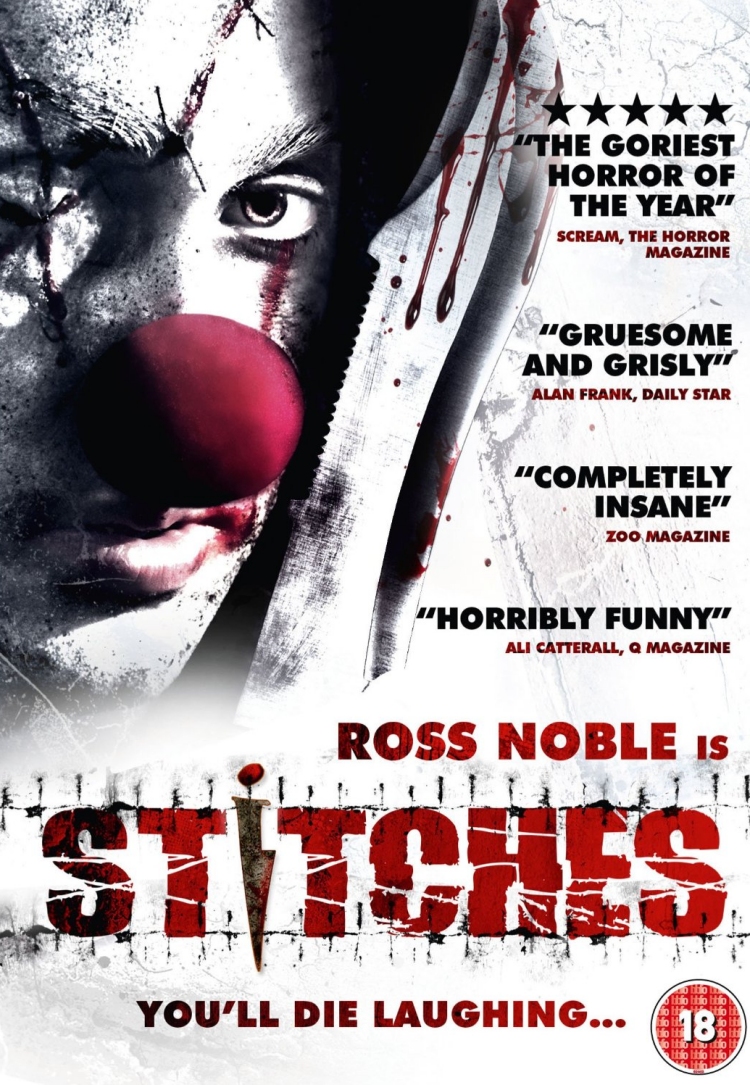
Stitches Review

"A joke is never a funny the second time 'round."

Through my teenage years I loved the improvisational stand up comedy of Ross Noble, then as he grew up, so did I. Despite this his stand up taught me at a critical age that its okay to think a little differently, and you can still find your way. One of the most intriguing things about Ross is that he would regularly turn down TV work in favour of his live shows. For many years Noble rejected many an acting role as the "wacky neighbour", which would probably have brought him a few years of safe income. How fitting it is that his first major role takes the form of a demented clown out for revenge.


'Stitches' is a down on his luck clown played by Noble, who is accidentally killed by a group of kids who are unappreciative of his act. He trips into the dishwasher and is impaled face first on a knife. Sound the irony alarm. One of the children Tom, whose party it was, suffers for many years with hallucinations and nightmares from the experience, and one day witnesses a bizarre ritual where it is claimed that no clown can ever rest peacefully if he is unable to complete a party. Many years later Tom is now having another birthday party of a more adult sort, which awakens the one eyed clown.

If I were to describe Stitches on a technical level, it would be 'crude'. Not quite student film crude, and believe me I've made a few, but definitely low budget. It falls into the same category as The Evil Dead as well made but also cheap looking but don;t get me wrong, theres nothing bad about that at all. I liked that the film doesn't look slick and polished. The mixture of mainly Irish, English and Geordie (Noble alone) accents is slightly jarring to the ear initially but you think about it less as the cast is gradually killed off in increasingly brutal ways. Various American high school movie tropes forced onto an Irish setting and the obligatory Facebook clone "My Face" make the film feel "cheesy', which has become a genre of its own these days. The one that grated on me most was a note reading "Enjoy your present, Mom".

Stitches' attacks are all loosely based on the fateful day of his death, and this is emphasised by flashbacks showing how each child disrespected him. My favourite cringey moment is when Stitches kills all nine lives of an obviously artificial cat by flailing it around the room. His outbursts all have an air of humour to them, whether it be a quip from the clown himself or the ridiculousness of the action, like an intestine balloon animal. Read that again, an intestine balloon animal. They were so happy with this creation that its in the films tagline. I didn't care for the films ending sequence, and the foreboding into a sequel seemed a bit over ambitious. There are many story problems here, but what exists is still cohesive, and even lends itself to a series, but I don't see one happening.

The problem with such wacky acts is that they lack believability, which ultimately makes the film not very scary but entertaining nonetheless. Stitches is a slasher film for people who don't really like horror, or are being initiated into the genre. It has blood and gore but not too many frights bar the obligatory jump scare. Nobles performance is consistently funny especially when he trying his best to be menacing. His delivery of lines is sometimes cringeworthy, but for his inexperience this is excusable. The role is a thousand miles from his stage persona, while at the same time being appropriate for him given that Nobles brand of comedy more resembles anarchy than a traditional stand up. He truly is an excellent casting. The rest of the cast was alright, not a noticeably bad performance between them and nobody stuck out as irritating or distracting, but as with slasher films the monster is the star. The problem many films like this is often the conclusion. Do you let the monster win, or if not how do you kill it? Stitches comes up with an interesting concept for its showdown that I didn't care for at first, but play itself out well. Stitches is at its best an original work with some unique ideas, and at its worst another slasher. the rest I suppose is up to you.