Thursday, 1 September 2016

Wakefield Cathedral Film Club: The Walk

Wakefield Cathedral Film Club will present The Walk on Monday September 19th at 7pm


Here is an exchange I've had a few times over the past few weeks:
"Have you seen The Walk?"
"No, whats it about?"
"Its a true story about a French man who tightrope walked between the twin towers."
"Oh... The twin towers? Those twin towers?"

At a first glance The Walk (2015) is one of those films that is about a stunning CGI visual and not much else, but that is not all this film has to offer. The Walk tells the story of Philippe Petit's passion and how he recruited the 'accomplices' who made his dream possible. Joseph Gordon-Levitt portrays Petit as obsessive and to a degree manic, often flying into fits of rage at the slightest backfire or at anyone who doubts him. Throughout this he remains likeable, and I found myself willing him to succeed. Having seen Petit himself describe the 'Coup' in interviews and in the documentary Man On Wire (2008), I can believe that this is an accurate portrayal of his mindset and how he speaks. In that film Petit describes entering the South tower in a van as "being engulfed by the monster". Lets face it, to plan a walk across a 140 foot cable with no safety measures for the sake of art you have to be a bit unhinged...

Incidentally Man On Wire is a great companion piece to this film, as it includes real footage of Philippe walking, running and even laying down on wires. More importantly it includes Petit's own telling of the story in great detail. There was a frankly baffling moment in The Walk where while looking for the arrow that was shot to connect the two towers with a string attached, Petit takes his clothes off in frustration. The real Petit confirms that this happened in the documentary, but this isn't explained very well in Levitt's performance or voiceover. The Walk very accurately and at times with the finest detail resembles Petits version of the story. The only notable exception being a performance in Sydney in 1973, and the Australian accomplice he met through this which are left out of the film presumably for time.

Levitt looks like a pro every time we see him on the wire and with good reason. He was taught his tightrope walking technique by the now 67 year old Philippe Petit, who correctly predicted this training would take no more than eight days. The rope walking scenes were shot for real at a hight of 12 feet, in front of a green screen. These scenes are spectacular, particularly shots that use a crane camera spinning around and hovering over Levitt. On a couple of occasions I actually felt a sense of dread come over me as if I was looking down at New York City for real. Sitting in my living room I can only imagine what this will look like on the silver screen. Director Robert Zemeckis was quoted as saying that "the goal was to evoke the feeling of vertigo. We worked really hard to put the audience up on those towers and on the wire." They definitely achieved this goal creating stunning and realistic visuals. While Joseph Gordon-Levitt puts on a great performance on the wire, his french accent was at times patchy. It wasn't quite John Cleese in Monty Python and the Holy Grail (1975), but at points in the film it smelled of elderberries a bit. To his credit though, his french speaking was much better. He is a known Francophile, so is accustomed to the language and already knew how to speak it before filming began.

While this is not intended to be a documentary, at times details which feel like important
are not explained by the film, almost as if it assumes we know already. This wouldn't be an issue to me if the film wasn't constantly cutting to Levitt as Petit standing on the Statue of Liberty talking directly to the viewer and explaining the story. These felt a little overdone and slightly lazy at times where things could be shown not told, but I understand they were essential to reminding the viewer that they are seeing everything from Philippe's perspective. This is really the only element of the film I didn't like but it at least had a reason to be included that makes sense.

One of the things I liked about the Walk is how well paced its 2 hour runtime is. The film divides into three sections, Petit discovering and working towards his goal, implementing the plan of getting all the equipment up to the roof and finally the 'Coup' itself as he repeatedly calls it. Language like this as well as 'accomplice' and 'Spy work' are a constant reminder that what Philippe is planning is technically illegal and this is necessary to add even more danger to the plan. The film at no time feels too long or that it is dragging which is impressive when you are building towards a big visual payoff that everyone knows is coming. The early scenes where Petit recruits his accomplices help with this as they move the story along progressively and are not lingered on for too long. Initially I felt like many of these characters are introduced and are merely window dressing for most of the film, particularly Annie who's main role in the Coup seems to be to watch from below. After watching Man On Wire I realised that the role of each of these people was to facilitate Philippe and not much more, and this no longer felt like a slight on the film. The real life Annie even says "my life was completely consumed by his and he never thought to ask me whether I had my own destiny to follow. It was quite clear I had to follow his." Only when I heard the real Annie say this did I truly understand that Philippe is the only developed character because that is true to the film, which is presented from the first person perspective of Philippe. A perspective that is obsessively focussed on his own dreams.

There is one final thing to discuss that I referenced at the start of this review. The film does a very good job of distracting you from thoughts about the other major event in the twin towers history, until one sad and impactful moment in the film. I think this affected me so much because I had been so completely invested in Philippe and his ambitious journey that September 11th 2001 had become the furthest thing from my mind. This is how I think Philippe's accomplices must have felt, fascinated and inspired by this eccentric character that wants only to do something amazing.


Wakefield Cathedral Film Club will be screening The Walk on Monday September 19th at 7pm.
Our Autumn to Winter 2016 season also includes
Hail Caesar! Saving Mr. Banks and A Christmas Carol.

Monday, 8 August 2016

Batman Vs Superman: Dawn of Justice

I might as well fess up now before it becomes a problem later, I quite liked this film. It sits among other things like post-2000 Simpsons and the 2015 Muppets TV series as things that are critically panned but I will will argue for regardless. I'm still going to blast it though, as while I enjoyed the film it still has big massive inescapable flaws.

For me this film was all about performance and style. It has the dark and brooding atmosphere you would expect from a Batman film, mixed with the clear cut psychology you might expect from a Superman film. Director Zack Snyder may have taken a beating for his previous films, but I felt like he did a great job recreating a Nolan Batman film in fast forward.

The big inescapable flaw is that the films structure is a bit of a nightmare. It feels like a three act structure is thrown out of the window in favour of something much less organised. Until the amazing battle where the two heroes clash it feels like no scene lasts longer than three minutes before cutting to something completely different Monty Python style. I hated this. It annoyed me greatly but I recognised that it was vital to setting up the payoff later on. I do think they could have been a bit better organised, and that this film plays better with a captive cinema audience than the ADD home movie crowd. Because the plot moves on so fast it would be easy to read a text and miss something important but subtle. Many of these brief scenes felt like they could have been fleshed out more or combined, to the point where you could have fit a whole film in to prevent the massive amount of storytelling required in the early stages, or perhaps tell part of the setup through clever internet marketing like The Dark Knight did. This film is essentially a direct sequel to Man of Steel, and so the lack of explanation for Supermans motivation is even more baffling given that Batman is muscling in on his franchise but seems to get more screen time. Its almost as if Superman isn't that interesting... To me the biggest flaw of this film is that they have an hour to create a feud out of nothing but a concept, and while it is a creative concept it does fall short. I enjoyed the story from Bruce Wayne's perspective. He witnesses the fallout of Man of Steel's climax first hand and saw many people he knew die. We rarely if ever see the mass destruction of a superhero battle from this angle, and this felt refreshing. While I enjoyed the story from Bruce's side, Supermans part of the feud feels like it lacks the foundations to justify the clash later on, but what a clash it is. I can't entirely blame this film though, as Batman has always had more depth, and will always be a more fleshed out character than Superman, despite Clark Kent getting a one film head start. To speak in gaudy franchise terms, a setup film for this would have done wonders.

Many people's complaint with the film is the same as it was with The Amazing Spiderman 2, a film that references the ill fated Sinister Six movie far too much. There is a fair amount of setup to the inescapable Justice League franchise. To be honest as a casual fan who likes Batman and tolerates everything else, I had to have this explained to me afterwards. I was vaguely aware of Aquaman and The Flash, but had no idea who Cyborg was, and frankly am still not. To my mind it is up to the film to explain this to me, not assume that I know already or that my friend sitting next to me will know. I also don't have much knowledge of Wonder Woman, much less that I knew she existed in the film (I went in blind as I always try to). I enjoyed her role however and she added to the story productively, not seeming to be thrown in for gratuitous reasons beyond sequel peddling.

While I'm on performances a lot has been made of Jesse Eisenberg's turn as Lex Luthor Jr. I used to hate Jesse Eisenberg with a passion, and this is the film that turned my perception of him upside down. I have since enjoyed him in End of The Tour, and I don't think I would have even watched that if he hadn't impressed me here. He strikes me as an evil genius with an accent of Batman villain madness and obsession. Again I am not speaking with any knowledge of the Lex Luthor than a more seasoned comic fan might, but I enjoyed the performance and await the next phase of the character.

For me the inevitable battle was the highlight of the film. Despite a sketchy build up the irresistible force meeting the immovable object certainly didn't disappoint me. I also enjoyed the additional clash with Doomsday, despite the quick cutting resulting in Lois Lane (Amy Adams) being underwater long enough to kill off eight of her nine lives yet somehow surviving. Before I watched the film I was made slightly hesitant by Amy Adams being so highly billed but I enjoyed her performance and how she was kept important throughout the story, even during the final battle. While I'm gushing about performances Ben Affleck made a great Batman, that is one thing everyone seems to agree on. He portrays a grizzled veteran, a much older and disillusioned version of the character never seen before in a major film. His character is reminiscent of The Dark Knight Returns (1986) graphic novel, and the films plot loosely eludes to this book several times. I also enjoyed Henry Cavil as Superman. Given that I couldn't finish Man of Steel for being bored to tears, I saw very little of his version, but I was pleased to see so much of Superman being Superman in this film. I was very happy to see plenty of both heroes being their cooler selves, and not two hours of Clark Kent and Bruce Wayne.

So we go back to the remedy. How could this film have been "saved"? The simple answer is that sadly, it couldn't. I can understand why many people didn't like Batman vs Superman. My theory is that part of the reason I was able to enjoy it is that I didn't really care about it until right before I sat in the cinema seat. I'm not interested in Marvel beyond Spiderman or until recently Guardians of the Galaxy, and I don't really know much about DC beyond Batman and his rouges gallery. I also noted that I tried to watch Man of Steel, but I just couldn't finish it due to the desperate attempt to push a back story rather than show anything to get excited about. What I'm trying to say is that as far as comic books go, I'm pretty much a casual fan, and I enjoyed this film as such. That being said I totally understand how you could have anticipated this film for years and found it to be a letdown in the end. Some people have been anticipating this film since I Am Legend (2007) cheekily referenced it. I watched this film with a friend who had been waiting, and I think if I had waited anxiously for Batman vs Superman, I might have felt let down as he said he did when the credits rolled. Incidentally, there is no post credit sequence. We waited until I got bored and googled it.

I also feel like there is another lesson here, metashitic is bad for you. This film has been mostly panned by proper critics, but audiences still turned out in droves to see it. I don't know how many of those droves liked what they saw, but I definitely did. I implore you to think for yourself in regards to this film, especially if like me you couldn't name the Justice League or Avengers if a gun was held to your temple. I enjoyed this film. You might enjoy it too if you give it a chance. I've also heard that the home release extended cut is much better, and I can believe that with the extra time it is given. This film has proved to be divisive, and it seems to me to be a division of superfans vs fans. I like this film, and I look forward to seeing Afflecks next appearance as Batman in Suicide Squad, as critically divisive as that might be...

Tuesday, 7 June 2016

A Royal Night Out film review

Wakefield Cathedral Film Club returns for a special screening of A Royal Night Out on June 10th at 7:15pm. Admission is free for a donation.


Generally speaking I like to go into films as blindly as possible so that I don't know what I'm in for. I usually avoid trailers and definitely reviews, and so this film was definitely a surprise to put it lightly. A Royal Night Out is definitely not the crusty biopic I was expecting, nor is it dull or boring in any way. It is absurd and ridiculous but crucially really fun throughout.

Watching A Royal Night Out felt to me like the classic scene in the 1951 Alice in Wonderland where Alice falls slowly down the rabbit hole. The film takes the generally accepted story that Princess' Elizabeth and Margaret went out among the unwashed masses on the night of VE day and runs wild with it. It takes the part that we know to be true and imagines what could have been if they had allowed to celebrate the end of the war at the Ritz, and the turn of events that follows is borderline surreal. I'm not going too far into the plot on purpose though, as it ought to be seen for yourself. The trailer uses the phrase "based on the untold story" but don't let this mislead you. A Royal Night Out resembles a Blackadder style bending of the truth, with every character boiled down to an instinct or single character trait. Elizabeth is 'the responsible one', who spends much of the film chasing down party animal Margaret who is portrayed almost as a Ben Elton character. She refers to herself as 'P2', and exclaims twice in the film that nobody cares what she does. While viewing the trailer for the film afterwrds I found that the moment audiences most responded positively to was Margaret asking the King "what is a knocking shop?" having been in one earlier in the film. The moment sets the tone for the entire film, its a road movie of sorts with a fair amount of good humour.

One thing I must praise A Royal Night Out for is its pacing. The film feels very much like a full night out, including the slow aftermath. It starts with the set up of a fun filled evening, reached a climax around midnight and peters off into the grim light of day by the final act, fortunately without a hangover. I did feel like I had experienced the highs and lows of a good night out in just 90 minutes, which I suppose is a testament to the films pacing and trueness to its premise. The only flaw I noticed is that Elizabeth appears to be awake for over 30 hours, and nobody could look that fresh and alert the following chasing Margaret around all night, except perhaps the Terminator. Some critics have also noted that the filmmakers grasp of London geography is shakey at best, but as a grim northener this didn't bother me.

I found all of the performances in the film to be stellar. I really liked Sarah Gadon as Elizabeth throughout, and grew to like Bel Powley as Margaret also. While we can question the films story in terms if its accuracy there is no question that they both tell the story brilliantly. No

matter how far we fall down the rabbit hole they handle it well. It is only when you stop and realise that Gadon and Powley are playing real living people that the story breaks a bit, but if you accept the film as a Carry On take on events, as entertainment over anything else then this is not an issue. At some point however reality must strike. Elizabeth was around 19 and Margaret 14 on the night in question, far from Gadon aged 28 and Powley age 23 at the time of the films release. Rupert Everett and Emily Watson also put in good performances (credited only as 'Queen' and 'King'), with Watson portraying an effective comic foil and Everett playing the little devil on the shoulder in cartoons. Their scenes only seem to move on when someone appeals to George IV's insecurity about his public perception, and this simplicity makes them nothing more well rounded than plot devices, but well acted ones regardless.

Once I got over the initial confusion of what I was watching, I really enjoyed A Royal Night Out. There were moments that made me laugh out loud that were supposed to, and a couple that weren't intended to. This film reminded me of a lot of the tone of classic comedy films, and this in itself is not a bad thing. What it means though is that the film is ultimately not very memorable and won't be on many peoples all time favourites lists, but it is still a fine piece of entertainment. I would recommend a Royal Night Out for a fun night out.

Monday, 23 May 2016

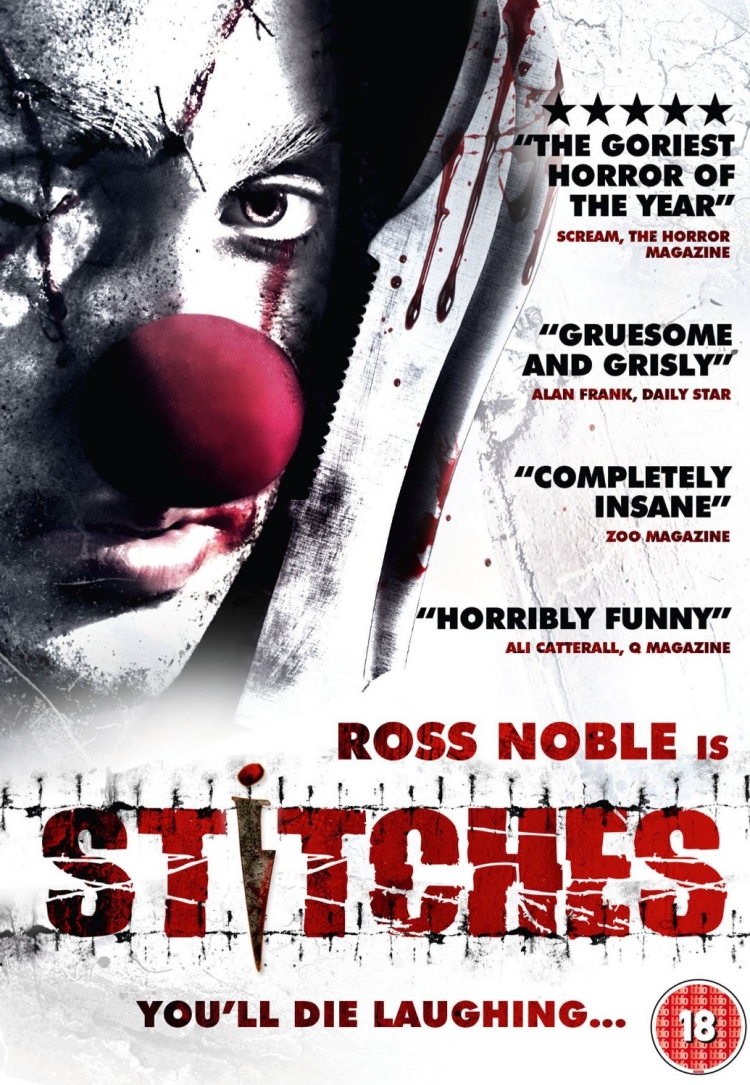
Stitches Review

"A joke is never a funny the second time 'round."

Through my teenage years I loved the improvisational stand up comedy of Ross Noble, then as he grew up, so did I. Despite this his stand up taught me at a critical age that its okay to think a little differently, and you can still find your way. One of the most intriguing things about Ross is that he would regularly turn down TV work in favour of his live shows. For many years Noble rejected many an acting role as the "wacky neighbour", which would probably have brought him a few years of safe income. How fitting it is that his first major role takes the form of a demented clown out for revenge.


'Stitches' is a down on his luck clown played by Noble, who is accidentally killed by a group of kids who are unappreciative of his act. He trips into the dishwasher and is impaled face first on a knife. Sound the irony alarm. One of the children Tom, whose party it was, suffers for many years with hallucinations and nightmares from the experience, and one day witnesses a bizarre ritual where it is claimed that no clown can ever rest peacefully if he is unable to complete a party. Many years later Tom is now having another birthday party of a more adult sort, which awakens the one eyed clown.

If I were to describe Stitches on a technical level, it would be 'crude'. Not quite student film crude, and believe me I've made a few, but definitely low budget. It falls into the same category as The Evil Dead as well made but also cheap looking but don;t get me wrong, theres nothing bad about that at all. I liked that the film doesn't look slick and polished. The mixture of mainly Irish, English and Geordie (Noble alone) accents is slightly jarring to the ear initially but you think about it less as the cast is gradually killed off in increasingly brutal ways. Various American high school movie tropes forced onto an Irish setting and the obligatory Facebook clone "My Face" make the film feel "cheesy', which has become a genre of its own these days. The one that grated on me most was a note reading "Enjoy your present, Mom".

Stitches' attacks are all loosely based on the fateful day of his death, and this is emphasised by flashbacks showing how each child disrespected him. My favourite cringey moment is when Stitches kills all nine lives of an obviously artificial cat by flailing it around the room. His outbursts all have an air of humour to them, whether it be a quip from the clown himself or the ridiculousness of the action, like an intestine balloon animal. Read that again, an intestine balloon animal. They were so happy with this creation that its in the films tagline. I didn't care for the films ending sequence, and the foreboding into a sequel seemed a bit over ambitious. There are many story problems here, but what exists is still cohesive, and even lends itself to a series, but I don't see one happening.

The problem with such wacky acts is that they lack believability, which ultimately makes the film not very scary but entertaining nonetheless. Stitches is a slasher film for people who don't really like horror, or are being initiated into the genre. It has blood and gore but not too many frights bar the obligatory jump scare. Nobles performance is consistently funny especially when he trying his best to be menacing. His delivery of lines is sometimes cringeworthy, but for his inexperience this is excusable. The role is a thousand miles from his stage persona, while at the same time being appropriate for him given that Nobles brand of comedy more resembles anarchy than a traditional stand up. He truly is an excellent casting. The rest of the cast was alright, not a noticeably bad performance between them and nobody stuck out as irritating or distracting, but as with slasher films the monster is the star. The problem many films like this is often the conclusion. Do you let the monster win, or if not how do you kill it? Stitches comes up with an interesting concept for its showdown that I didn't care for at first, but play itself out well. Stitches is at its best an original work with some unique ideas, and at its worst another slasher. the rest I suppose is up to you.

Saturday, 16 April 2016

Wakefield Cathedral Film Club: The Lady in the Van

Wakefield Cathedral Film Club will present The Lady in the Van on Monday April 18th at 7pm


So it's all been building to this. The Lady in the Van is our season finale before we take a Summer break. When our line up was announced I considered The Lady in the Van to be a bit of an odd choice, but having seen it I completely understood. Watching The Lady in the Van for me felt like watching a vintage BBC comedy. It took me back to my childhood, watching witty Roy Clarke sitcoms with my family. I don't think I've ever seen a film that had quite that affect on me. This film was my introduction to the world of Alan Bennett. It truly does feel like you are sucked into his world, and I didn't want to leave.

Alex Jennings portrays Alan Bennett as two versions of the man himself at odds with each other. "There is the self that does the writing and the self that does the living". These two versions of Bennett are highly entertaining while also highly critical of Bennett as a whole. In a film written by Alan Bennett, Alan Bennett doesn't exactly shine, and that is very much on purpose. The moments with the two bickering were some of my favourites of the film. They feel honest and relatable while still being humorous. Self depreciating rather than self aggrandising. If I had to criticise anything it would be that the curse words often felt forced and played for an unexpected laugh, which to me felt a little tame in this age. As the same actor is playing two identical roles there are some shots where keeping track of which is which becomes confusing, but it is a still a stellar performance from both Jennings, who had played Bennett previously on stage and had a grasp of his unique delivery and style already. These scenes are also impressive on a technical level, particularly a brief moment where one Bennett throws an object the the other catches it. This might not seem like much but as a filmmaker it left me baffled and wanting to know how it was done, like a magic trick.

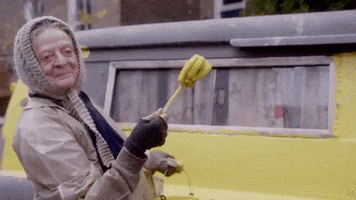
Maggie Smith as Miss Shepherd is so good that she deserved her own paragraph. Miss Shepherd is the most comic character in the film by far, but also the most sympathetic. The real Alan Bennett has said in interviews that he was thoroughly annoyed by the lady herself, and you can see that despite the warm affection the film gives her, mostly through Smiths engaging performance. Being both funny and empathetic convincingly is a challenging task for any actor but Dame Smith excels. I was
surprised to find myself moved by the subplot that is Miss Shepherds hatred of music, initially used as a comic device but later as a touching element to her character. The Lady in the Van is not the sort of film where any character goes through an arc. Nobody develops or changes in any way by design so such a subplot was needed to allow us to care about her a little more. The Lady in the Van is not an overtly emotional film, but one scene in the later act really changed my perception of the film and Dame Smiths character specifically. Given the nature of the character, Miss Shepherds eccentricity was always going to be a barrier but they found a clever way around that by humanising her gradually as the film progresses. That isn't to say that Maggie Smith's acting is at any point unbelievable, but the characters uniqueness could have easily gone the way of Baldrick from Blackadder, ridiculous yet sympathetic. Dame Smiths performance instead takes a more realistic approach, and its all the better for it. You always get the impression Miss Shepherd knows exactly what she is doing, like Edmund Blackadder himself, to stretch that comparison as far as it'll go.

Speaking of humour, I can't decide whether The Lady in the Van is a funny film, an effective comedy, or not. That's for you to decide I suppose. Many times I laughed out loud but mainly at things that spoke to me personally. I know this from watching the trailer with others at our previous screenings and finding that the gags I loved were often met with silence, particularly a moment when Miss Shepherd is screeching while chasing young children who are singing in the street away as though they were birds on her washing line. I have seen this clip about a million times now, and the sound of her yelling still makes me laugh, but when I showed this to people not a peep. Similarly there were jokes in the trailer that passed me by while they killed with our Boychoir audience. That is perhaps my favourite thing about The Lady in the Van, it truly speaks to your own experience, relating to others differently.

Alan Bennett is a master of self depreciating humour, but also a master it seems of depreciating humour too:

Bennett: Maybe you could come 'round and help with the decorating?
Actor in Bennett's play: Sure. My girlfriends a dab hand with painting.

Maybe I'm looking too much into this line, but maybe I'm not. I can't quite decide, but I found the line fascinating any many more lines will jump out at your own experiences. The films script is witty and scathing while at the same time engaging and charming. Few films I can think of ride the line between comedic and emotional so well, and that is high praise not just for the writing, but also for the relatable yet eccentric performances. As a boy brought up and raised on British sitcom humour, often based in pessimistic and relentless circumstances, this film excels while still keeping its emotional core in tact. See this film if you miss the glory days of British comedy, or yearn for a renaissance in British film. Both are well exemplified here.


Wakefield Cathedral Film Club will be taking a hiatus until September. To be the first to receive information on our return, please get in touch with us at www.wakefieldcathedral.org.uk

Wednesday, 23 March 2016

The Good Dinosaur

Since I recently wrote about Wakefield Cathedral Film Club's next film Jurassic World, I thought I'd choose another recent prehistoric themed picture. The Good Dinosaur is largely seen as the 'other' Pixar film from 2015, as it was released in the same year as Inside Out, more on that later I'm guessing. That being said despite Pixar having a few flops under its belt in recent years, the 'other' Pixar film is still not a damning term, especially for my generation who grew up with their films. 2015 was the first ever year Pixar released two films, and so comparisons based on that alone were bound to be made, but watching these films feels like a completely different experience.

The Good Dinosaur is in many ways a mass of contradiction. Throughout the film I enjoyed the vast, beautiful and at times photorealistic landscapes. I was amazed at how lifelike the natural surroundings looked at times, particularly in sweeping panoramic shots. This is jarring however compared to the cartoony looking dinosaur characters, as well as their goofy sounding voices and movements. At times they more resemble giraffes which I found very distracting, with the main character Arlo's movements being modelled on those of a young elephant. For the visual presentation I get the feeling the designers were bizarrely fixated on Dino from the Flintstones. There
were many times in the film where I would be taken back by a stunning landscape only to be shot down by Arlo using words like "Papa" It's truly disheartening that they made a better looking dinosaur in Rex from Toy Story, which was released twenty years ago, and that you would think someone at Pixar would have pointed this out. While the visuals has some issues the soundtrack of the film is truly masterful. The film was originally to be scored by Thomas Newman who has produced noteworthy scores in the past for films like American Beauty (1999), Wall-E (2008) and recent James Bond films Skyfall (2012) and Spectre (2015). There is still a hint of an American Beauty percussion based style in the end result, and Mychael and Jeff Danna's take impressed me greatly. The music genuinely kept me hooked at some points.

The film begins with an asteroid missing Earth, and jumps forward to our present day where Humans bizarrely haven't evolved yet dinosaurs have. The herbivores have developed a farming system, and somehow the English language. Our main character Arlo has two parents and two siblings, and is very much the baby of the family, easily getting scared by most things. The three siblings are brought up aiming to 'make their mark', meaning a literal mark on their crop silo, which Arlo has failed to do so far due to his fear. Following the loss of his "Papa" in a scene that loosely resembles Mufasa's fate in The Lion King (1994), Arlo finds himself lost miles away from home with the human child who unintentionally cost his Father his life . In order to survive the journey home he finds he must bond with the canine-like human. Arlo names the human 'Spot', as he behaves much like a Dog would, because this is apparently how evolution works. Spot at one point howls at the moon, which I found particularly annoying. While the film does a respectable job in attempting to unite these two characters it required too much suspension of disbelief for me to truly get behind it. Arlo as a character is constantly plagued by fear while Spot isn't, and this is what is used to draw us into believing the unity between the two, but this isn't enough. If someone who was responsible for my parents death and I was stuck with them, I would struggle to forgive them in the way Arlo does despite anything, and I don't think I'm alone in that. It simply doesn't feel logical and this is where the film lost me.

Here is where the major issue with The Good Dinosaur lies. Pixar has shown in the past that it can create compelling characters using very little dialogue, so it baffles me why they chose not to with this film. Wall-E (2008) features no dialogue between two on screen characters until 45 minutes in, and not very much after that also. This shows me that Pixar knows how to create lovable characters without a word being spoken and yet The Good Dinosaur insists on going in another direction. I was interested to find that lead Writer and Director of Wall-E Andrew Stanton is credited as an Executive Producer for this film, but then so is original head of Pixar John Lasseter, whose pictures often involve humanising characters from Toys to Bugs to Cars. I get that they probably didn't want anyone to think it was too much like their previous work, but like in Jurassic World where Owen Grady names each raptor in his control, you don't need to humanise everything. Their differences to us are what make them interesting. To my mind the end result would have been much better with a silent protagonist relying on body language to draw the viewer in.

As a minor criticism I don't really get what is 'Good' about Arlo Naive or Scared would have been more truthful. More bafflingly one of the films tagline's is "little arms big attitude", which makes even less sense as I couldn't find much attitude. Perhaps it got cut out of rewrite 47.

This film suffered from well documented "story problems", which is to be read as "quality issues" that sadly weren't addressed fully. This isn't helped by director changes and release date delays, which are often bad signs. Toy Story 2 (1999) was completely rewritten and remade from scratch despite being almost finished because Director John Lasseter felt the story didn't work, yet it still came out on its originally announced date. Lasseter has since said that this completely drained him, so in Pixars defence I can see why they would want to take their time if they felt a picture wasn't working. Many reviewers point to a specific scene where Arlo and Spot find a way to communicate the losses they have each experienced (pictured above) as a highlight, but to me this felt tacky and bolted on as a way to force these two characters together. When I watched this scene a second time it made me realise I would have enjoyed the story more if the roles were revered, if Arlo was somehow responsible for Spots parents doom. It was less like fine embroidery and more banging two pieces of wood together and hoping they stick.

Thanks to the amazing scenery and music I could never brand The Good
Dinosaur as a bad film, or even a low quality one, just a film of great technical achievement but sadly poor storytelling. Toy Story being amazing doesn't make A Bugs Life a bad film, but it still sits on the dusty end of the shelf in peoples minds when they think of Pixar greats. Inside Out being amazing doesn't make The Good Dinosaur a bad film, which is why it will rest on that shelf too. You know, the same shelf with that wheezing penguin from Toy Story 2...
Who incidentally is also better animated than Arlo.

Tuesday, 8 March 2016

Wakefield Cathedral Film Club: The Choir

Wakefield Cathedral Film Club will present The Choir on Monday March 14th at 7pm


Two men walking down a corridor:
"E Flat"
"Excuse me?"
"The note your shoe is squeaking."


I wasn't originally planning to write about The Choir, or Boychoir as it is also known. I wanted to bury it under someones patio and pretend it hadn't existed. When I first saw the trailer I cringed. I cringed at the above E Flat exchange, at the use of Zadok the Priest, and at the use of Eddie Izzard in a dramatic role. Was the whole film going to be like this? Well, the answer is yes, but let me explain why that turned into a positive.

The films trailer to me played like every underdog sports film ever, except the plucky underprivileged team in this case is a young boy named Stet. Yes, as in Stetson (more on that later). Stet is a problem child, who lives in a trailer with his alcoholic Mother and is prone to violent outbursts in school. His saving grace appears to be that he inexplicably possesses the voice of an angel. Stets life is turned upside down when his Mother is involved in a fatal car accident, and he is forced onto his absent Father who lives in New York. It becomes clear that Stet is a secret child, and so he is sent away to a musical boarding school so that he remains a shady secret to his wife and daughters. This becomes one of the most intriguing parts of the film. The trailer would have you believe that the films crescendo (see what I did there) builds up to "the most important concert in our schools history", a line that made me cringe. It appears to build to a big Zadok The Priest set piece at the end akin to the small town nobodies winning the Superbowl, World Series or insert your top prize here. The concert is important but by this point the film is more focused on Stet and his development. I liked the major twist that happens at this concert, despite the slightly ropey acting that made one choirboys actions unintentionally hilarious.

I laughed at ropey acting a fair bit in this film, but to my mind that is better than if the film were boring. Much like Jurassic World where I played 'spot the product placement', in this film I played 'spot the American cliche', and this kept me very entertained.  The phrase "knock it out of the ballpark" is used twice. TWICE! If you accept that the film is very American in every sense, the ride is a lot more enjoyable. The main character is called Stetson. The only way the film could get any more American would be to name his Mother Nascar. I know this sounds like a criticism but it isn't. I enjoyed this film more as a comedy than as a dramatic work, but at least that helped me enjoy it. It is Acorn Antiques, not Crossroads, and that is fine.


The single greatest thing in the film is Dustin Hoffman as Master Carvelle, as he has the best performed role and is a joy to watch. He is every grizzled veteran character ever, a teacher who is able to take even an unruly child like Stet and harness his talent. A scene about half way through the film best shows this as Carvelle tests Stet while bringing the stage lights up brighter and brighter as if to interrogate him about whether he truly has a passion for singing. Hoffman appears to know that he is playing chief stereotype in an entire film filled with stereotypes, and he seems fine with that, so I am fine with it too. The musical performances in Boychoir are also a very enjoyable aspect throughout the film.

I found Boychoir to be a far more enjoyable experience once I got past my skepticism brought on by the trailer and other things I had read. The Choir is consistently well shot and directed for the most part, though some scenes in Churches felt like they forgot to turn the lights on. Aside from an ending you are either going to love or hate, Boychoir is worth 96 minutes of your time. I came to enjoy it as a nod to choral music with a Hollywood touch.


Wakefield Cathedral Film Club is screening Boychoir on Monday March 14th at 7pm.
Tickets cost £5 on the door and refreshments will be served.

Our next screening is Alan Bennett's The Lady in the Van on April 18th.